


Seen from above, the southern tip of Ibiza has a distinctive shape. Between the airport, Es Cavallet, and Ses Salines Beach, the typical rugged Mediterranean landscape suddenly gives way to straight lines. Long embankments divide the land into shallow rectangular ponds, flanked by narrow canals that carry water from one basin to another. Their colors change depending on depth, salinity, the microorganisms they contain, and the light they receive.
Today, we tend to view this area primarily as a natural space. Ses Salines is part of a protected natural park, an important wetland for migratory birds, and is undoubtedly one of Ibiza’s most iconic landscapes.
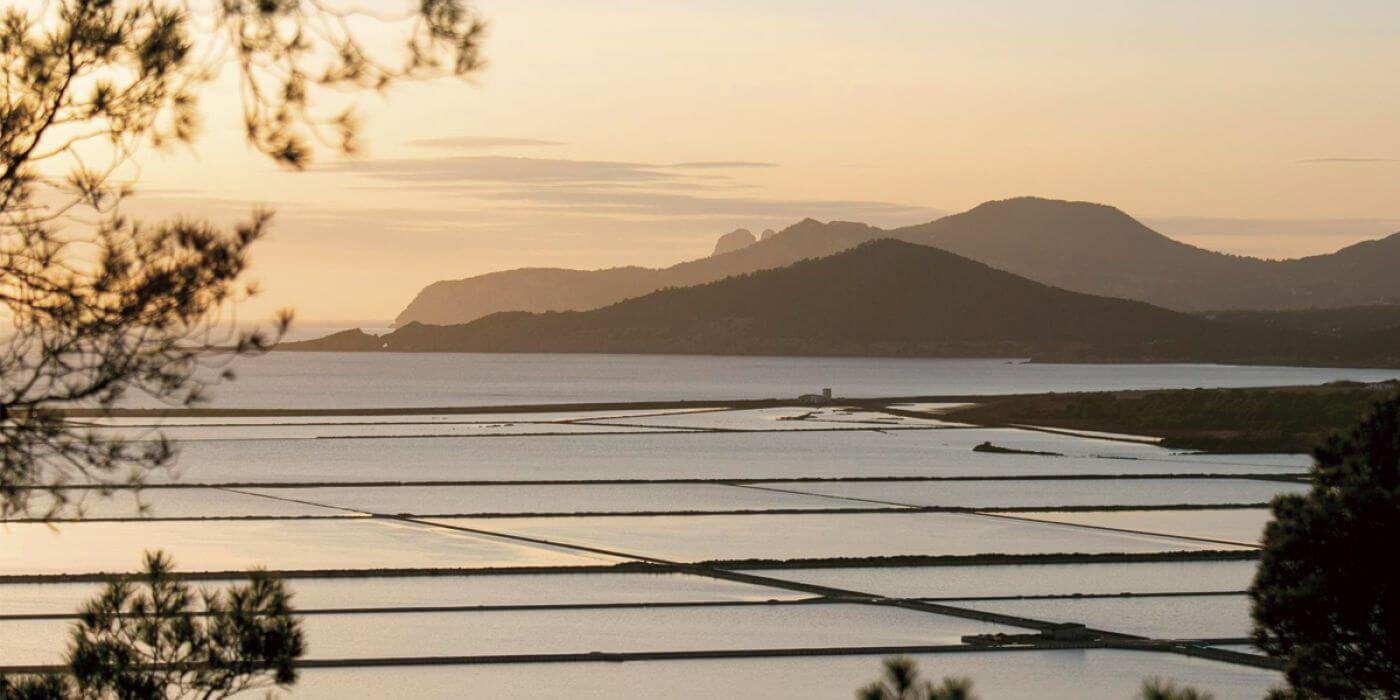
However, there is another way to view that same landscape, since the salt flats are still in operation.
It could also be described as a machine, one whose energy comes mainly from the sun and whose raw material comes from the sea. The land has been divided, channeled, and managed so that the water can be concentrated until something that is normally invisible within it becomes solid enough to be shoveled into piles. For a long time, that product was one of Ibiza’s most significant links to the outside world.
From our modern perspective, it’s easy to overlook salt because it’s cheap. A package bought at a supermarket gives little sense of the economic importance this mineral once held. However, before modern refrigeration and transportation, access to salt had significance that went far beyond simply seasoning food. It made it possible to preserve fish, meat, and many other foods; while helping to supply ships, it also facilitated trade in these foods and provided governments with a resource that was easy to control and tax.
In the case of Ibiza, the history dates back at least to the time when Phoenician settlers established themselves on the island more than 2,600 years ago. Exactly how they used the salt flats is harder to determine than is sometimes suggested, as there is a gap between what is highly plausible and what archaeology has actually proven. But contrary to what it might seem, that gap actually makes the story more interesting.
Why was salt valuable if the sea was full of it?
There is an apparent problem with the idea that salt was a valuable commodity: Ibiza is surrounded by seawater. In a warm climate, salt water left in a shallow puddle eventually evaporates. Which raises an obvious question: why would what appears to be waste be valuable?
The answer begins with the difference between a raw material and a usable product. Seawater was abundant, but in the past, large-scale salt production required a rather unusual combination of conditions. There had to be suitable flat land, intense evaporation, a manageable supply of seawater, relatively little rainfall during the critical phases of the production cycle, and enough space to transport the brine between the different areas. In addition, the ponds and canals required maintenance, and after harvesting, the salt had to be collected, kept dry, stored, and transported. Seawater was free, but a reliable saltworks not so much.
Southern Ibiza offered favorable geographical conditions for salt production. Benjamí Costa Ribas and Carmen Alfaro Giner, in their study on salt, fishing, and salted fish in the Pitiusas Islands, describe the natural conditions of Ibiza and Formentera as particularly suitable for the production of sea salt. They also highlight the product’s higher quality, which has been historically recognized.
This distinction helps explain an apparent economic paradox. Scarcity does not mean that the substance in question has to be rare on Earth. What matters is how much of it can be obtained, in a useful form, in a specific location and at a given cost. A sailor may be surrounded by seawater yet still face a shortage of drinking water. Salt works the other way around: it is dissolved in virtually all seawater, but turning it into tons of clean, dry, transportable crystals requires a suitable landscape, infrastructure, and considerable organization.
The distance to trade routes and ports was also important. Inland, each additional stage of transport required more labor and incurred higher costs, since salt is heavy. Having direct access to maritime transport was particularly important, further limiting the viable locations for large-scale salt production.
For Ibiza, this was a fortunate combination: salt could be produced right next to the Mediterranean Sea, which in turn offered a direct route to distant customers. In other words, the sea provided both the raw material and a cheap and efficient means of transportation.
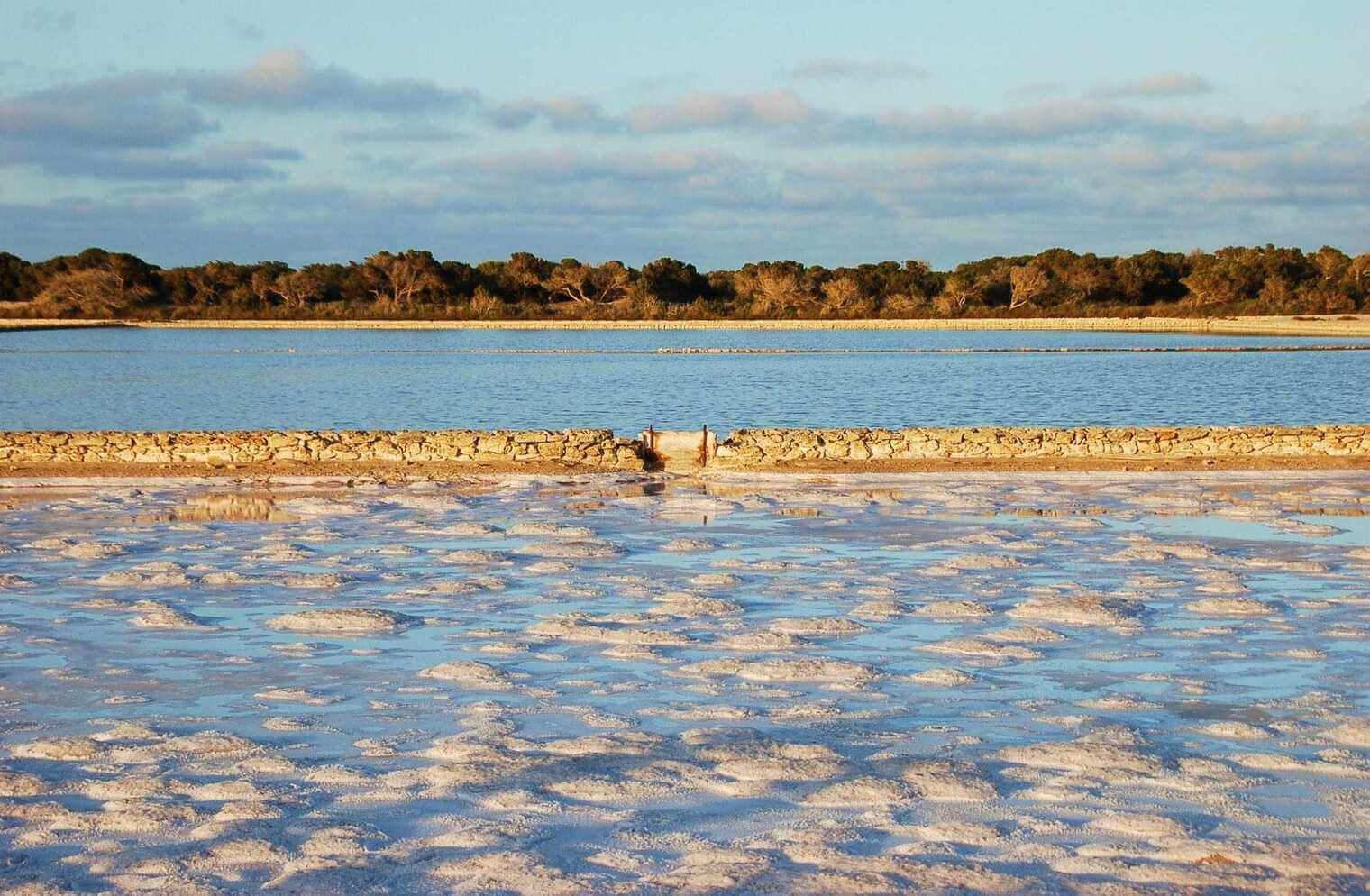
Ses Salines. Foto: Amparo Arias
Salt was used for more than just adding flavor to food
The value of salt is easier to understand when we stop thinking of it as something you sprinkle on a prepared dish.
One of the fundamental problems of a preindustrial economy was food spoilage. Fish and meat could lose much of their value if they were not consumed quickly. Harvests and catches were seasonal, while people needed to feed themselves year-round. Long journeys exacerbated this problem.
Salting was one of several preservation methods used in the ancient world, along with drying, smoking, fermentation, and pickling. It had both economic and culinary implications.
The process works because salt draws some of the water out of the food and reduces the amount of water available to microorganisms, significantly slowing their growth. When properly salted (and often dried as well), fish could be preserved for several months, rather than just a few days. Other comparable traditional techniques can extend preservation to about six months under the right conditions. Before consumption, excess salt could be removed by washing the fish and soaking it in fresh water—sometimes changing the water several times—before cooking it or using it in another dish.
Therefore, thanks to salting, preserved foods could last longer between production and consumption. It was no longer necessary to consume a large catch almost immediately. Some products could be transported much farther from their place of origin, and at the same time, ships could carry provisions for longer voyages.
Salt increased the value of other goods. Fish was one commodity and salt was another, but when the two were combined through processing, packaging, and transportation, the result could become a product suitable for long-distance trade. Thus, salt enabled food to be transported in two new ways: across geography and across time.
The Western Phoenician world, and later the Punic (i.e. Carthaginian) world, developed significant industries centered on the processing of fish and salted products. Archaeological research on these industries reveals networks that encompassed fishing, processing, the manufacture of containers, trade, and maritime transport. This was more than just a single, isolated activity.
This distinction is particularly useful when we return to Ibiza. While salt was important to the island’s ancient economy, its significance could not be measured solely by the quantity of raw salt exported. Salt could also support other activities: fishermen needed equipment, preserved goods required containers, and amphorae required potters and kilns. Likewise, cargo needed storage; goods had to reach a landing site and be loaded onto ships; ships required crews, repairs, and knowledge of routes and weather conditions, and so on. This is how a simple resource—yet one of great importance due to its utility—begins to create an economic ecosystem around it.
Did salt ever become money?
Salt is also known for having once served as money. There is some truth to this idea, but the most widely known version is too simplistic.
Salt has been used directly as a medium of exchange in certain societies, and in other places it has served as a highly prized commodity or as a direct form of payment. But it would be misleading to imagine that, in the ancient Mediterranean, blocks of salt were generally used in place of coins.
Nevertheless, the most interesting question is how salt might have occasionally acquired qualities similar to those of money.
A useful medium of exchange benefits from being recognizable and divisible; it must hold up reasonably well during storage; and, of course, other people must want it. Ideally, demand would extend beyond a small group of buyers.
It turns out that salt met these requirements surprisingly well: it could be divided without losing its basic utility; if stored properly, it remained in good condition for very long periods; it was easily recognizable; most societies needed it; and part of that demand was continually renewed because salt was consumed.
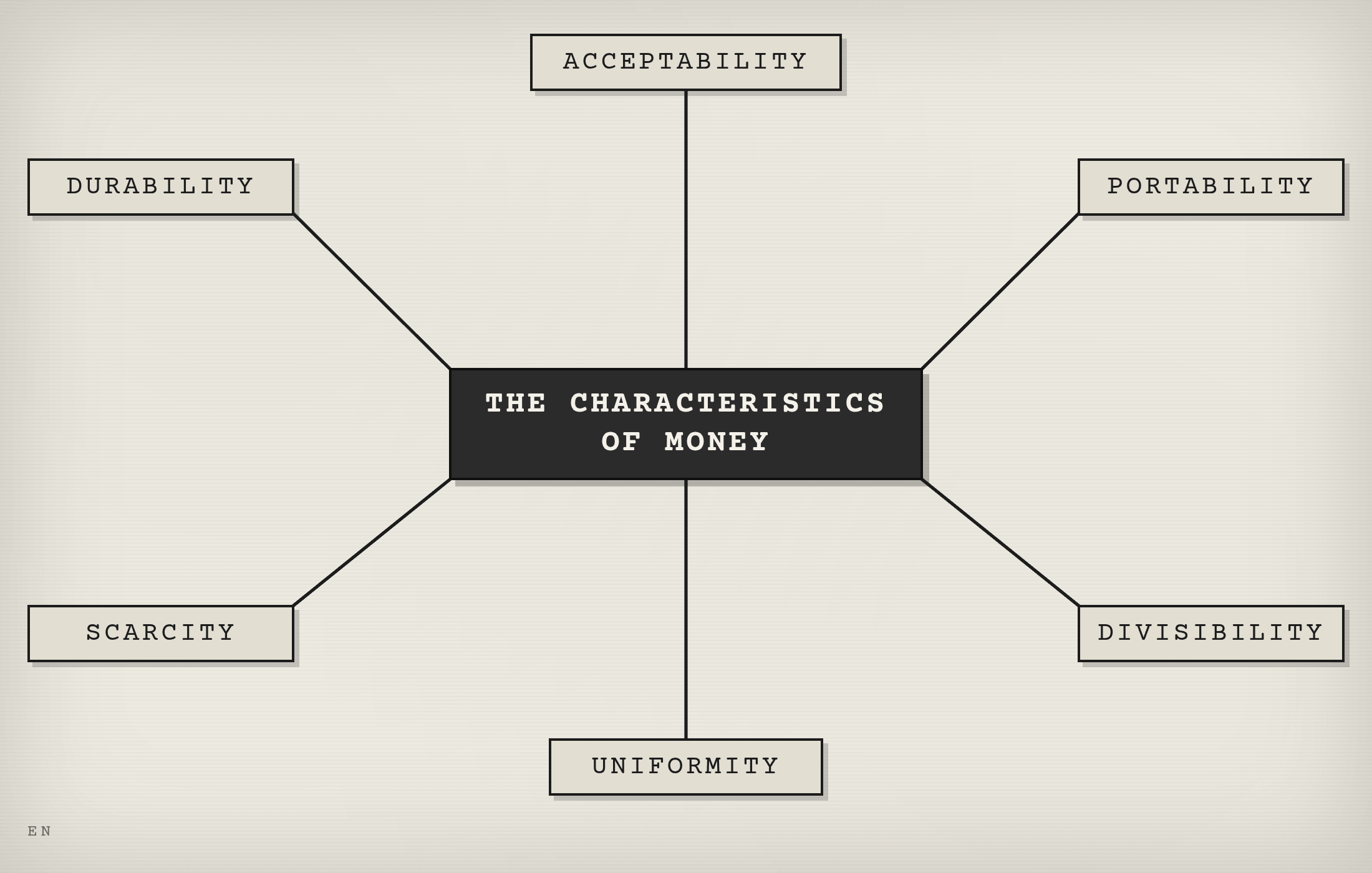
But there was another unusual phenomenon: grain was essential but perishable; gold was durable and scarce, but largely non-consumable. Salt fell somewhere in between: it kept well, but was continuously consumed, which contributed to its relative scarcity (perhaps the most important attribute of money). This helps explain why salt could function as a reliable medium of exchange even when it was not officially recognized as money.
The famous connection between salt and the word “salary” should also be approached with caution. The word ultimately derives from the Latin salarium, a term related to salt. The oft-repeated claim that Roman soldiers were paid simply with salt is far less certain than the etymological connection itself. Even modern academic and reference sources differ on the extent to which that connection should be interpreted literally. Nevertheless, we can say with certainty that salt was indeed important enough in Roman economic life to leave a linguistic mark related to payment.
But its political importance went further: salt was an attractive commodity for the authorities because its production tended to be geographically concentrated, while demand was widespread. A government did not need to seek out salt at every single trading post; rather, it was enough to control the production area, the distribution route, or the point of sale for much of the trade to be exposed.
Consequently, salt repeatedly became a source of taxation, monopoly, and political control. This will become particularly clear in the subsequent history of Ibiza.
The Phoenicians, Sa Caleta, and the mystery of the missing salt flats
The strongest temptation when recounting the ancient history of Ses Salines is to write a concise sentence:
“The Phoenicians arrived and built the salt flats.”
But we don’t know that.
The first Phoenician settlement identified with certainty in Ibiza is Sa Caleta, on the southern coast. UNESCO dates the first Phoenician occupation to the 8th century B.C. The settlement was later abandoned, around the beginning of the 6th century B.C., as the population moved toward the site of present-day Ibiza Town.
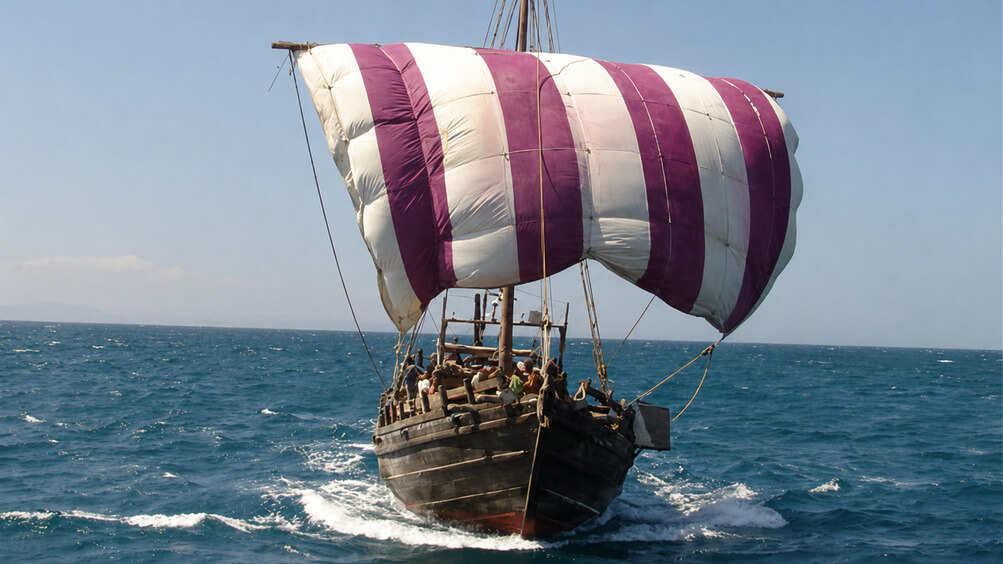
A modern replica of a Phoenician merchant ship during a voyage across the Atlantic. Source
At just 1,500 meters away, Sa Caleta is located very close to the landscape dedicated to salt production. It is understandable that this geographical relationship has drawn attention. UNESCO’s own official assessment mentions the settlement’s location near the salt flats, while the archaeological interpretation of its economy includes fishing and the exploitation of nearby resources. Archaeological finds include fishhooks, and the settlement’s overall maritime character is well established. The location also placed its inhabitants alongside a landscape suitable for salt production. These facts make the connection between the settlement, fishing, and salt economically compelling.
However, the missing piece of the puzzle is archaeological evidence of the infrastructure itself. Costa Ribas and Alfaro Giner highlight this problem. Despite the favorable natural conditions of the Pitiusas Islands and their long historical tradition related to salt, no direct archaeological evidence of salt production facilities of Phoenician-Punic or even Roman origin has been identified that would allow for the accurate reconstruction of the ancient saltworks.
Therefore, the rectangular ponds that can be seen today should not be interpreted as preserved examples of Phoenician engineering.
It is most likely that salt production began in a much simpler form and underwent repeated changes, in a manner more or less analogous to what occurred with freshwater architecture in Ibiza. Natural depressions along the coastline could concentrate seawater even before a complex infrastructure existed. The Phoenicians, however, did not arrive in Ibiza without knowledge of salt production: it is documented in other parts of the Phoenician-Punic world and was part of a technical and commercial tradition with which they were already familiar. In Ibiza, this knowledge could be applied to a landscape that already produced salt naturally, progressively improving it through water control, the separation of basins, the construction of embankments, the excavation of canals, and the expansion of the productive area. What we do not know is how much of this process occurred during the first Phoenician occupation and how much corresponds to expansions in subsequent centuries.
Later, over the centuries, one generation inherited the modifications made by another. The result resembles less a building with a specific construction date and more a landscape with a history. We know that the saltworks were ancient. Today, we cannot reconstruct their Phoenician form.
This very process of growth helps explain why it is so difficult today to find a clearly defined “Phoenician salt flat.” Salt flats are a type of infrastructure particularly ill-suited to preserving their original layout intact over millennia. Their operation requires the periodic repair and reconstruction of dikes, canals, partitions between ponds, and ditches; furthermore, the productive area of Ses Salines expanded over time, especially beginning in the 19th century. Costa Ribas and Alfaro Giner believe that these later transformations may have obscured much of the original layout. In infrastructure of this type, continued use can ultimately erase precisely the oldest phases of its own history.
There is, however, a unique archaeological find at the Sal Rossa site. On the embankments that once bordered ancient salt pans, several arrowheads were discovered alongside pottery and coins dating from the Phoenician-Punic period. According to the study by Costa Ribas and Alfaro Giner, this is the site on the entire island where the highest concentration of this type of projectile has been found: eleven date to the Archaic period and four to the Punic period, and based on their typology, they are considered weapons of war, not hunting tools. The authors cautiously suggest the possibility that these finds may reflect some form of military control or defense of the salt flats from the earliest phases of the Phoenician presence. While this is not conclusive evidence, it does raise an intriguing question: if this resource needed to be protected, what economic value had it already acquired by that time?
What other Phoenician sites can tell us — and what they can’t
At this point, the comparison is useful, provided it is clearly identified as such.
Costa Ribas and Alfaro Giner broaden their perspective beyond Ibiza to other Phoenician and Punic centers where data is more abundant. They analyze inscriptions from places such as Cyprus, Carthage, and Sardinia that appear to link officials to salt production or trade. They also compare the geographical role of the Pitiusas Islands with that of other salt-producing centers in the Mediterranean.
This indicates that the organized exploitation of salt was fully compatible with the economic world to which ancient Ibiza belonged.
But this does not prove that Ibiza used the same administrative system, since no document has survived that names an official responsible for overseeing the saltworks of Ebusus, the Phoenician name for Ibiza, during the Phoenician period. We do not know whether the resource belonged to a temple, a political authority, merchant groups, families, or some shifting combination of interests.
The comparison offers possibilities rather than answers. Even so, it is valuable. Archaeology is often uneven. One site may preserve an inscription but lack an industrial facility; another may preserve pottery but no accounting records; a third may have a saltworks complex but offer few clues as to who controlled it.
When analyzed together, comparable sites can reveal the variety of systems that existed. In the case of Ibiza, the key conclusion is quite modest: salt production was not merely a secondary activity. It was a natural part of the maritime economy of the Phoenician and Punic western Mediterranean.
What can a small island sell?
Ibiza has another economic limitation that is easy to overlook. It is an island of just 570 square kilometers. Arable land is limited, as the terrain is mostly mountainous. The same is true of forests, fresh water, and many raw materials. A population that lives exclusively off what such a territory can produce will eventually reach its limits.
However, trade changed the equation. An island did not need to produce everything its inhabitants consumed if it possessed something that was in demand elsewhere. Salt is particularly useful in this context because its production did not require sacrificing fertile agricultural land, as might be the case with the expansion of grain cultivation. The resource was found in a coastal environment, with its own unique value: seawater, evaporation, and flat terrain.
This does not mean that salt alone brought about the prosperity of ancient Ibiza. The island relied on agriculture, fishing, artisanal production, and other exports. Furthermore, its location along the maritime routes of the western Mediterranean was of enormous importance. But a resource that was in high demand, exportable, and reliably available offered opportunities in a league of its own.
Archaeological evidence shows that Phoenician and Punic Ibiza was far from isolated. UNESCO describes Sa Caleta and Puig des Molins as evidence of the important role the island played in the Mediterranean economy during the Phoenician-Carthaginian period.
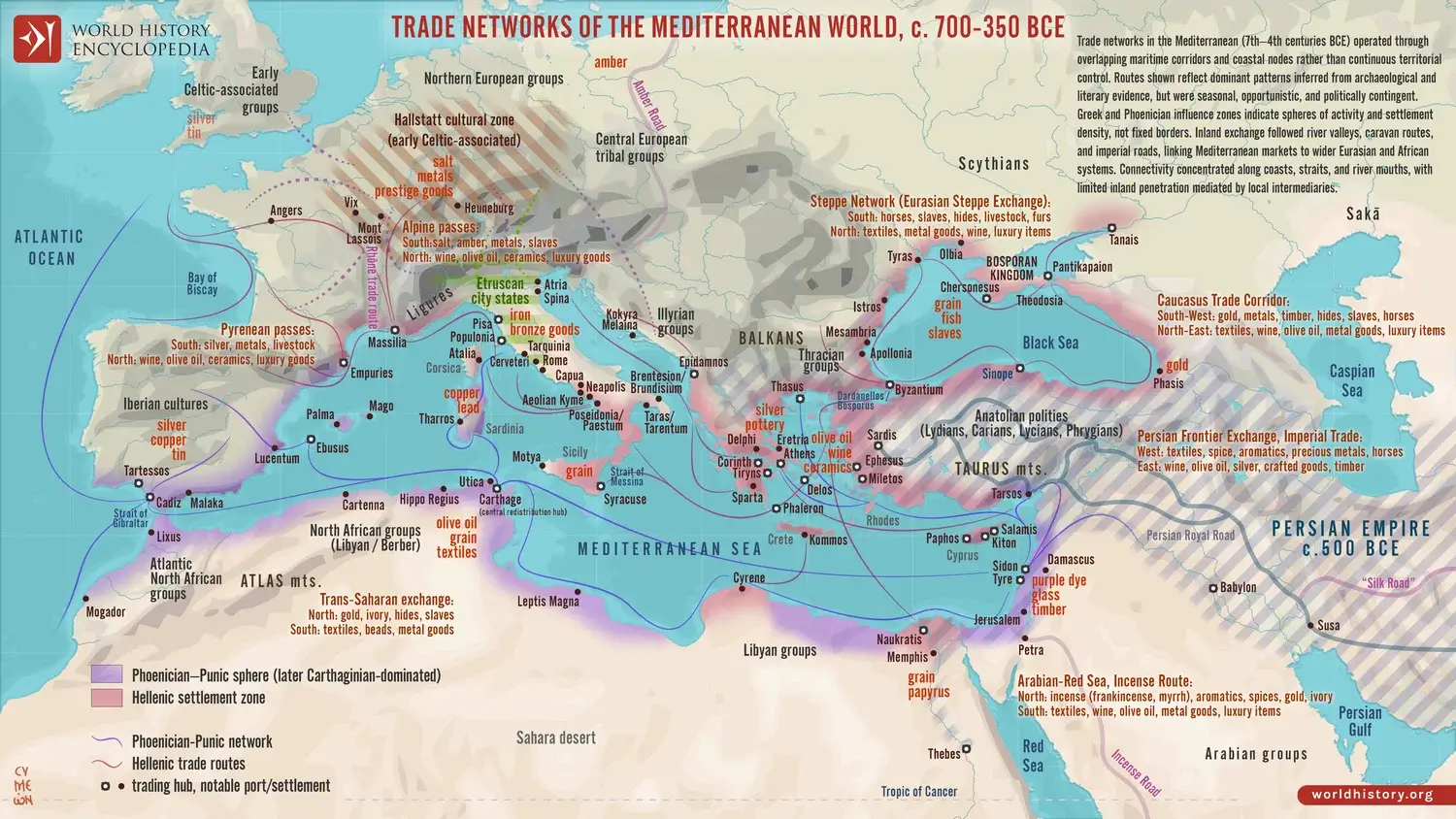
Main trade routes and production centers for the most important goods in antiquity. Source
As the settlement developed, Ibiza gradually became integrated into the trade routes that extended to the Iberian coast and other parts of the western Mediterranean. Amphorae, pottery, and other artifacts document these relationships more reliably than any surviving ledger.
It is often said that Ibiza “exported salt.”
The most interesting question is what benefits this participation in trade brought.
We cannot take an imported ceramic vessel and prove that it was purchased with the proceeds from a specific shipment of salt. Ancient trade does not leave us an invoice with that level of detail. But an export-based economy provided a small island with access to resources and finished products that could not be easily produced locally.
That is why exports are important beyond the merchant who sells them, since they make it possible to exchange a good that is abundant locally for something that was in short supply on the island.
Salt, fishing, and a more specialized economy
There is another possibility worth considering carefully.
A society that produces solely for its immediate subsistence has limited scope for specialization, but one that generates surpluses and trades them can support people whose work becomes increasingly specialized.
Salt and preserved fish are a good example, as the production chain quickly extended beyond the person who harvested either of these resources.
Research on Punic fish-processing industries in other parts of the western Mediterranean identifies fishing, salting, the production of ceramic vessels, trade, and maritime transport as interrelated activities. The growth of such industries could increase the division of labor and occupational specialization.
It would be an exaggeration to claim that Ibiza’s population grew because of salt, or that its urban development can be explained by a salt industry that we cannot quantify archaeologically. Nevertheless, the economic mechanism is significant.
If Ibiza produced goods for external markets, the consequences could ripple throughout the local economy. Some residents made containers, others maintained the boats, others transported the goods, others organized trade, and so on. Fishermen and farmers could supply people who devoted more time to other tasks. This is precisely an example of ecosystems that led to the specialization of labor and, consequently, to greater productivity and trade in surpluses, which in turn benefited the local society as a whole.
A commercial society gradually becomes more complex as new occupations emerge. Perhaps this is a better way to consider the possible role of salt in the island’s early development.
A geography shaped by a heavy good
Salt has another characteristic that has shaped its history: it is bulky and heavy.
A sack of salt is neither a jewel nor a rare dye. If a sufficient quantity needs to be moved, transportation accounts for a large portion of its cost. This gives coastal production a significant advantage.
Long before modern roads or engines existed, a boat could transport bulk cargo farther and more efficiently than the repeated overland trips made by people and animals. Ibiza’s salt flats were located alongside an already well-established maritime world.
This is relevant when analyzing southern Ibiza, as the landscape required connections between production and water transport. The subsequent historical use of coastal docks around the salt flats highlights this relationship. Archaeological studies of Ibiza’s secondary anchorages mention, for example, Sa Sal Rossa as a landing stage associated with the salt flats, while also noting the limitations that its shallow depth imposed on larger vessels.
Not all physical remains from different eras should be interpreted as dating back to antiquity. But the logistical problem is timeless.
Economic geography arises from the movement of a product. Salt had to leave the saltworks, and from there, routes emerged. The saltworks were connected by roads, and these led to storage or loading sites. The shipping points, in turn, were connected to ships, and the ships connected the island to markets that may never have seen the landscape from which the salt originated.
Seen in this light, Ses Salines was larger than the visible salt flats. Its historical footprint extends to roads, buildings, ports, ships, and trade relations.
A resource valuable enough to govern
The evidence becomes increasingly solid as time goes on.
Following the Catalan conquest of Ibiza in 1235, salt was clearly no longer a marginal product. The salt flats emerged as a fundamental economic resource in the island’s medieval organization, and the revenue derived from salt became closely linked to local government.
The founding of the Universitat de Ibiza in the late 13th century provided the island with a local governing institution whose finances were closely tied to the revenue generated by salt. The details changed over time, as did the rights related to production and sale, but the general idea is hard to overlook: a coastal mineral had become part of the island’s fiscal structure.
This later evidence does not prove that the Phoenician rulers organized the salt industry in the same way, but it does reveal something about the resource itself: once a productive saltworks existed, political authorities took it very seriously.
Production was geographically concentrated, the product was easily quantifiable, and export routes passed through identifiable points. Compared to trying to tax thousands of small, scattered transactions, salt offered the authorities a visible economic bottleneck.
The history of salt taxes and the salt monopoly, far beyond Ibiza, shows just how attractive that combination could be. In Ibiza, control of the salt flats was repeatedly intertwined with the question of who benefited from one of the island’s most reliable resources.
Ses Salines were never completed
It is tempting to imagine ancient industries as something that was created at a certain point in time and then passed down unchanged.
Ses Salines does not fit that image. The salt-pan landscape was repeatedly modified as methods, ownership, labor, and technology changed. The vast geometric system visible today is the result of cumulative interventions, rather than a plan preserved from antiquity.
This distinction is important because it changes what we mean when we describe Ses Salines as “ancient.” Its antiquity lies primarily in the continuity of its use, not in the fact that every surviving wall or pond is ancient.
In fact, this has been the norm among productive landscapes: agricultural terraces were repaired, irrigation systems were rerouted, harbors were dredged or expanded, roads were relocated, and so on. The salt flats followed the same pattern. The fundamental physical principles have hardly changed, while almost everything surrounding that process has: people improved water management, the ponds were expanded or subdivided, pumps replaced older methods of water transfer, and railroads—and later, trucks—changed how the harvested salt was transported. Likewise, storage and loading infrastructure has become more efficient.
In the 19th century, the saltworks entered a more distinctly industrial phase. Ownership and management changed, including the sale of state-owned saltworks to private hands in 1871, after which new investments and infrastructure further transformed production.
This later history provides us with something that archaeology cannot offer regarding the first millennium B.C.: documentation of how people deliberately modified the landscape to increase productivity. Therefore, it would be surprising if earlier societies had not altered it as well. We simply cannot yet reconstruct their interventions with the same precision.
From hundreds of salt workers to a mechanized industry
The most radical transformation of work at Ses Salines took place between the late 19th century and the mid-20th century. Following the privatization of the salt flats in 1871, the operation entered a phase of heavy investment. Beginning in 1885, under the direction of engineer Eugeni Molina, ponds and mounds were rebuilt, rainwater was diverted, new canals were dug, and transportation systems were modernized. Within a few years, the facilities began to closely resemble the salt flats we know today.
One of those innovations was particularly unique to Ibiza. In 1896, a small railway network was installed to connect the ponds and storage areas with the Sa Canal pier. It was the only railroad ever to operate on the island. Its railcars made it possible to move large quantities of the heavy cargo without having to transport it entirely by hand or on horseback. The railroad remained in operation until 1972, when it was replaced by tractors with trailers; some remnants of the tracks can still be found in the area surrounding the salt flats.
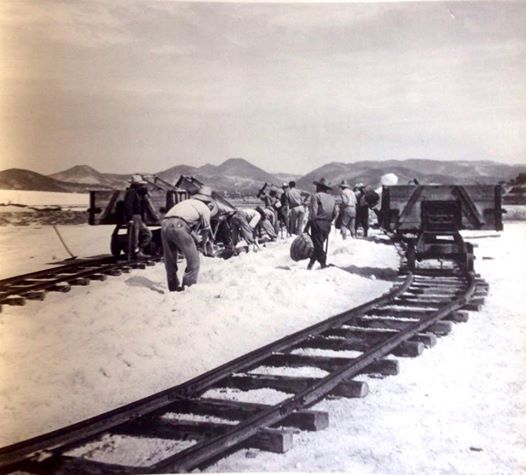
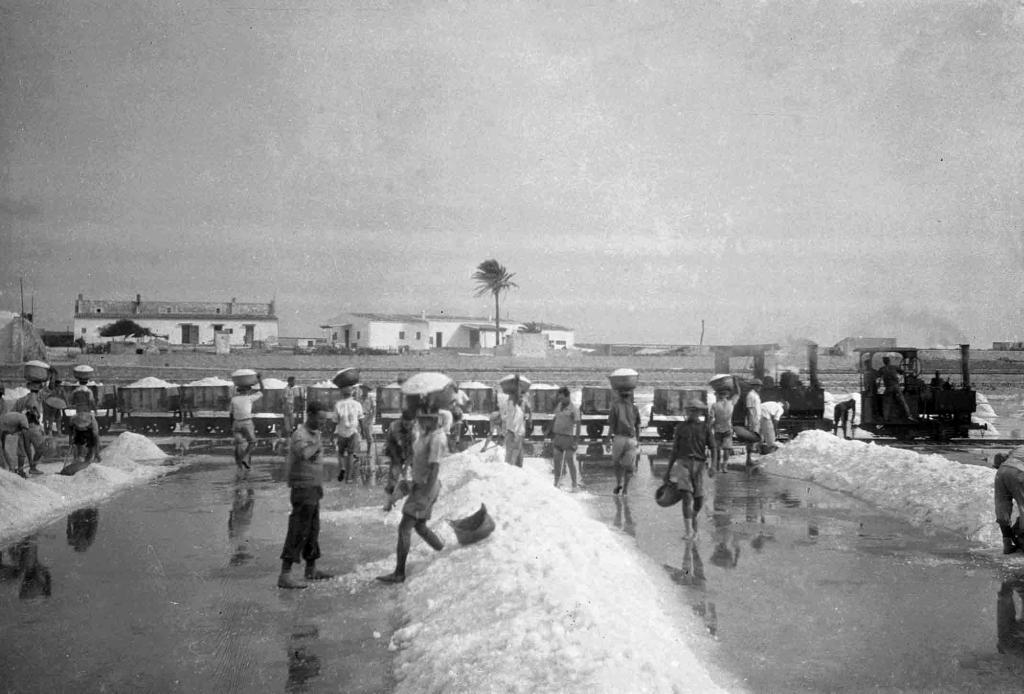
Laborers and the Ses Salines railroad (early 20th century)
Even so, for much of the first half of the 20th century, the harvest continued to depend heavily on people. Harvesting took place mainly at the end of summer and drew workers from different parts of Ibiza, many of them farmers who found a temporary source of income there once their other agricultural tasks were completed. The salt was broken up and collected by hand and transported in large baskets to wagons or collection points. At its peak, the industry employed around a thousand people; official statistics even recorded higher figures in some years.

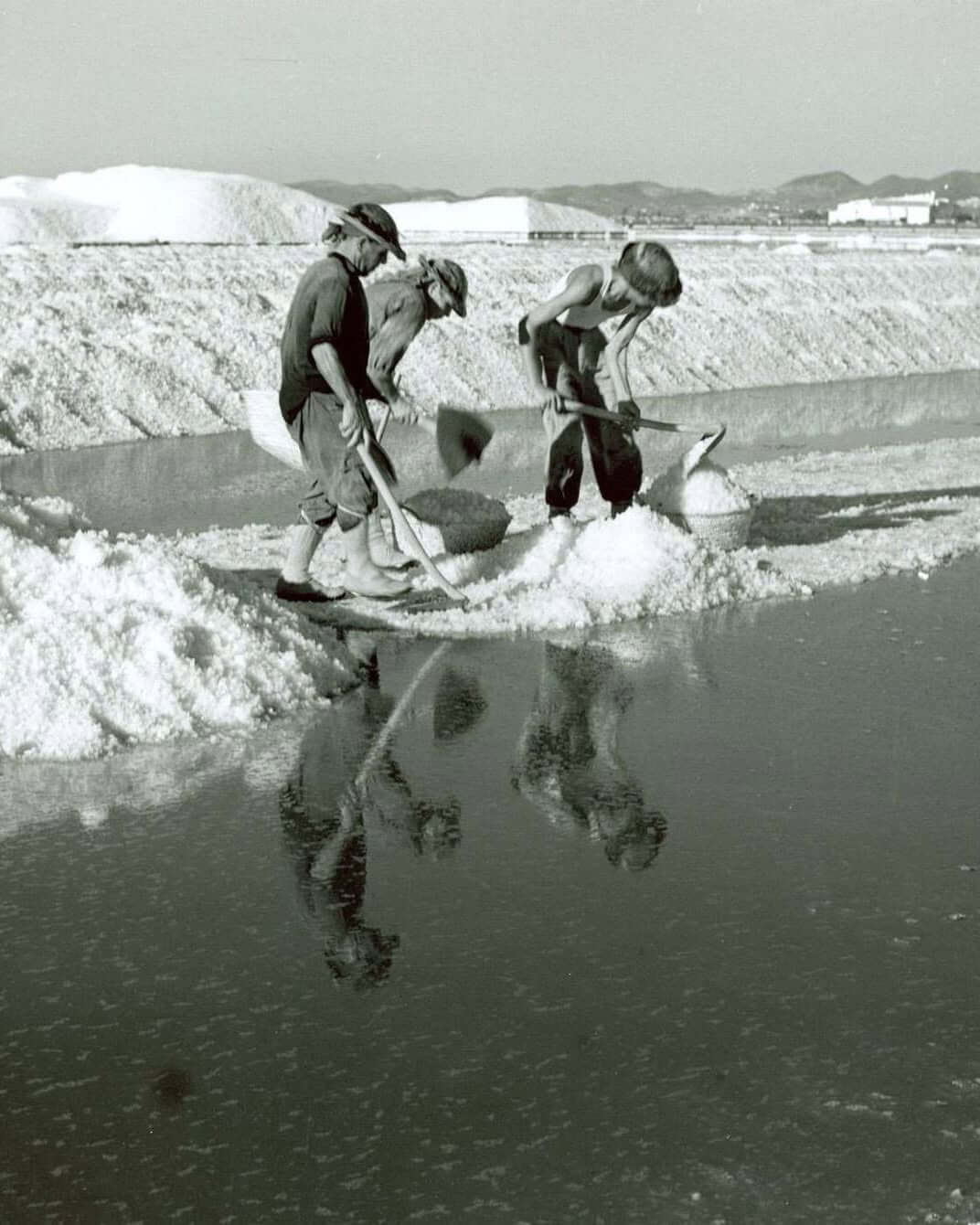
Historical photos of work at Ses Salines (mid-20th century)
This system underwent a decisive change beginning in 1955, when Salinera Española also began to mechanize the extraction process itself. With a small permanent crew, the machinery could perform much of the work that had previously required hundreds of seasonal workers. It was not necessary for production to cease for the old trade to disappear; rather, the same quantities of salt could be harvested with a fraction of the workforce.
At the same time, the economy surrounding the salt flats was changing. The growth of tourism from the late 1950s and, above all, throughout the 1960s offered considerably better-paying jobs to many Ibicencans. Some former salt field workers recall leaving the sector because of the higher wages they could earn in hotels and other tourism-related businesses. The market for salt itself was also changing: electric refrigeration and freezers in ships gradually reduced the enormous demand that the fishing industry had maintained for centuries to preserve its catches. Salinera Española responded by seeking other markets and uses for its product.
Therefore, it does not appear that manual salt harvesting came to an end due to a single collapse in the price of salt or a halt in production. The salt flats of Ibiza continued to produce salt during this transition. Rather, it was the convergence of two transformations: machines required less and less labor, and the new tourism economy offered that labor force more attractive jobs. Salt continued to be produced in Ibiza; what disappeared almost entirely was the multitude of salt workers who, for generations, had made its harvest possible.
From working landscape to protected landscape
Almost ironically, centuries of salt production created and sustained a vast landscape of open wetlands in southern Ibiza. In the 20th century, as urban development pressure on the rest of the island increased dramatically, Ses Salines took on a different kind of value.
Environmental protection became increasingly important starting in the 1970s. The area was granted successive layers of legal protection and was finally designated the Ses Salines d’Eivissa i Formentera Natural Park in 1999. Its salt flats are also recognized under the Ramsar Convention as wetlands of international importance.
Its highly saline waters, surrounding wetlands, and seasonal changes support specialized ecosystems and provide feeding and resting areas for numerous bird species. The park’s official records list approximately 210 bird species, including flamingos, black-winged stilts, black-tailed godwits, and other migratory and resident birds.
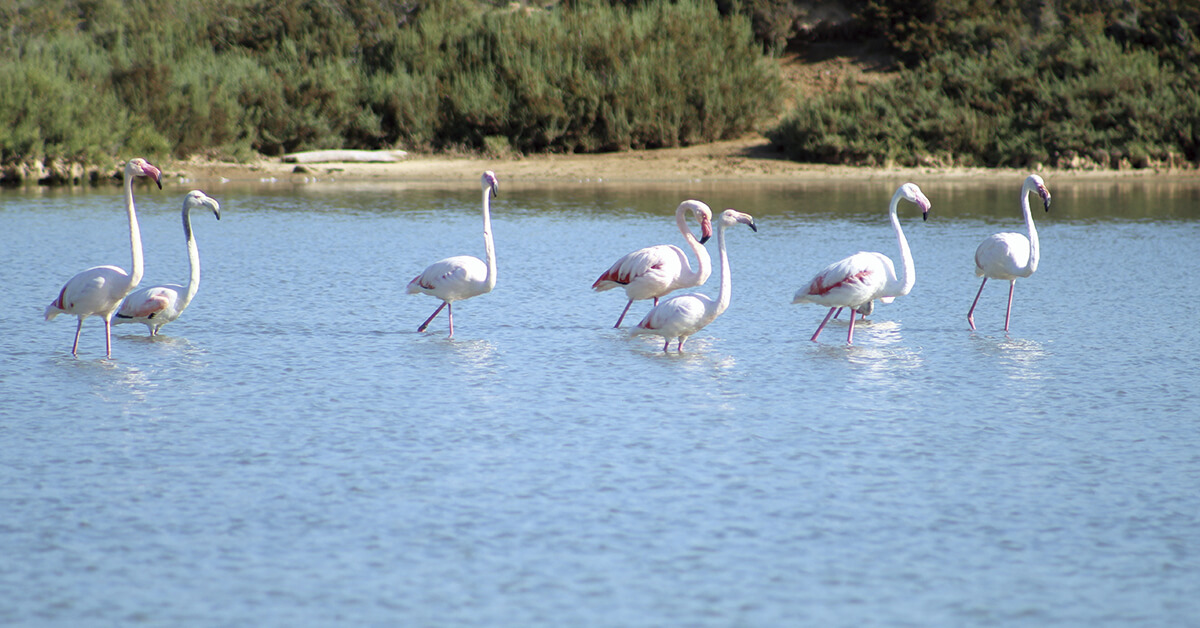
This results in an unusual overlap, as the landscape is both industrial and ecological. Despite having been shaped by humans for generations, it has become one of Ibiza’s most important protected natural areas.
The apparent contradiction disappears as soon as we stop viewing the “natural” and the “artificial” as opposites. Some landscapes are the result of a long negotiation between the two.
The story that was written into the landscape
Today, the economic importance of salt has diminished to the point that many visitors may stand next to Ses Salines without giving any of this a second thought. What catches the eye, however, are the calm waters, the color of the salt flats, the birds, the flat horizon, and the unusual emptiness of a vast expanse in southern Ibiza.
Ses Salines has survived precisely because it never stood still. What began as a coastal environment naturally conducive to salt formation soon became a productive landscape; it was expanded and reorganized by successive generations, managed as a source of tax revenue for centuries, industrialized in the 19th century, traversed by Ibiza’s only railroad, and finally mechanized to the point where it now requires only a fraction of the workforce it once did.
Each era left something behind and erased something else: the new salt ponds covered earlier layouts; machinery replaced the salt workers, and tractors replaced the railroad; refrigeration reduced some of the uses that had made salt a strategic product. Its function even changed again when, in the last third of the 20th century, the very same territory that had been exploited for centuries began to be protected for its ecological value.
That is why it is difficult to assign Ses Salines a single identity. It is a wetland, an industry, a heritage site, an ecosystem, and a historical archive all at once. The physical principles that made it useful have hardly changed: a coastal plain, seawater, sunshine, and evaporation. Around them, however, one can trace much of Ibiza’s economic history.
Main sources and references:
Academia.edu / estudio arqueológico: “Salt, Fishing and Salted Fish in the Pitiusas in Antiquity” (2008), by Benjamí Costa Ribas and Carmen Alfaro Giner
Dialnet / arqueología de Ibiza: “Economía y comercio de la Ibiza púnica en la época de las acuñaciones de moneda (siglos IV a. C.–I d. C.)” (2013), by Joan Ramon Torres
Universitat de Barcelona: “El paisaje de las explotaciones salineras litorales mediterráneas: el caso de las salinas de Ibiza” (2015), by Cristina Ruiz Lozano