


Long before Ibiza became internationally synonymous with electronic music, big nightclubs, and luxury tourism, the island was already attracting a different kind of traveler. Painters, architects, writers, and intellectuals arrived in search of something that was becoming scarce in Europe’s major cities: time, seclusion, a relatively inexpensive lifestyle, and a landscape that seemed far removed from the established cultural hubs.
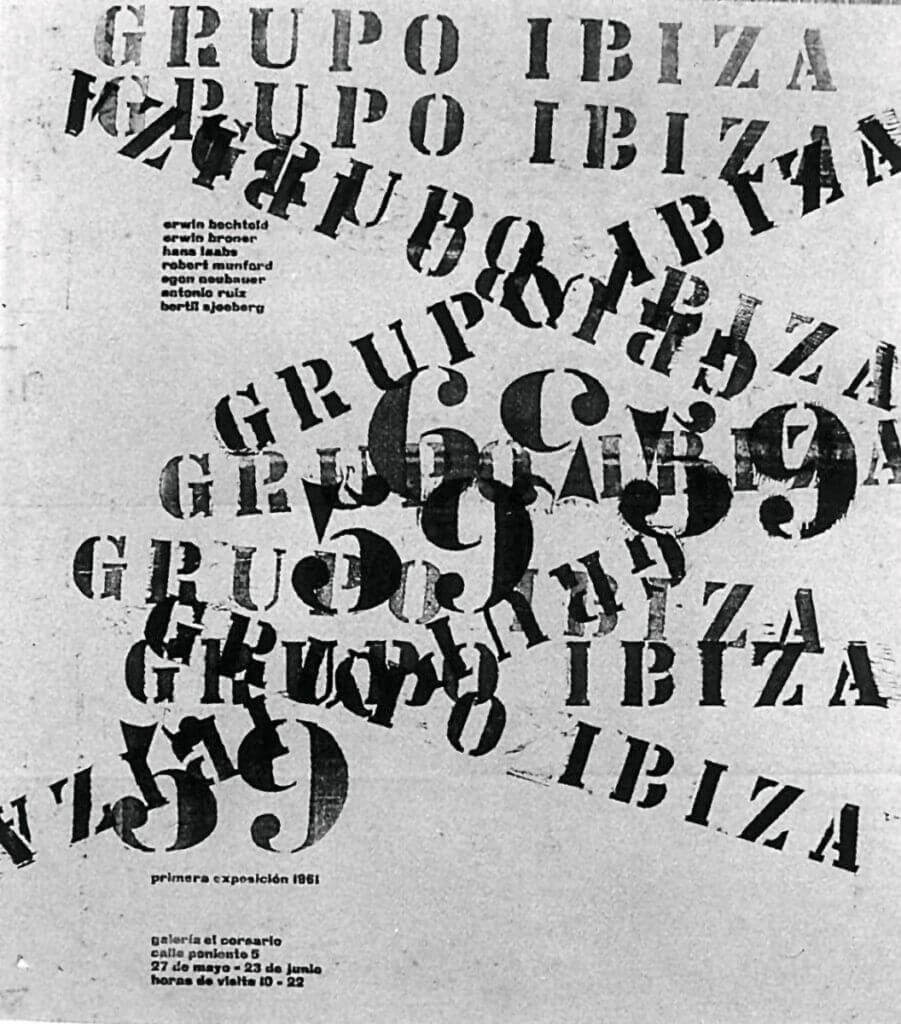
From that atmosphere, Grupo Ibiza 59 was born in 1959, initially consisting of nine artists residing on the island: Erwin Broner, Erwin Bechtold, Hans Laabs, Katja Meirowsky, Robert “Bob” Munford, Egon Neubauer, Antonio Ruiz, Bertil Sjöberg, and Heinz Trökes. Later, other artists would become associated with the group, including Carlos Sansegundo, Bob Thompson, and Pierre Haubensak.
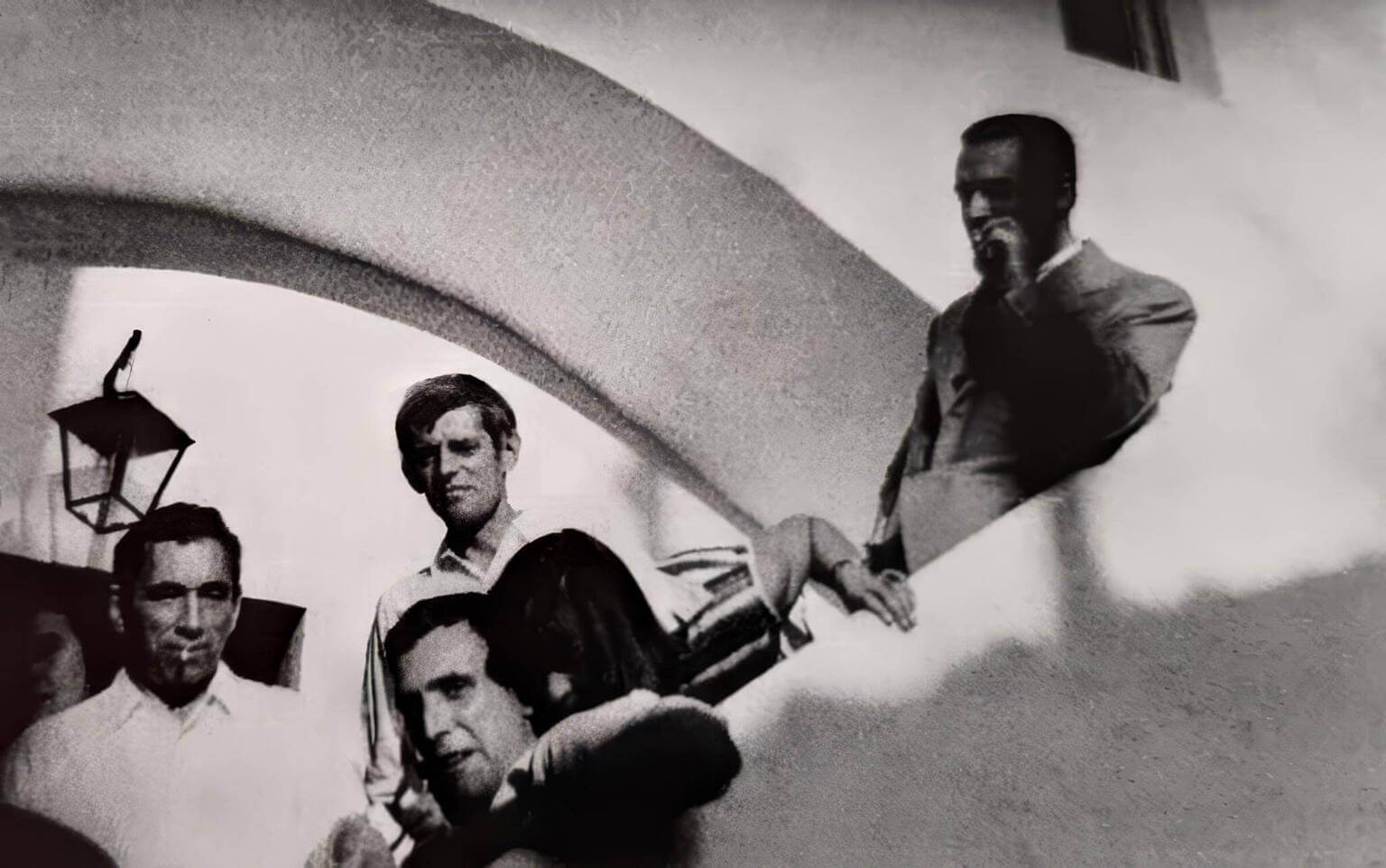
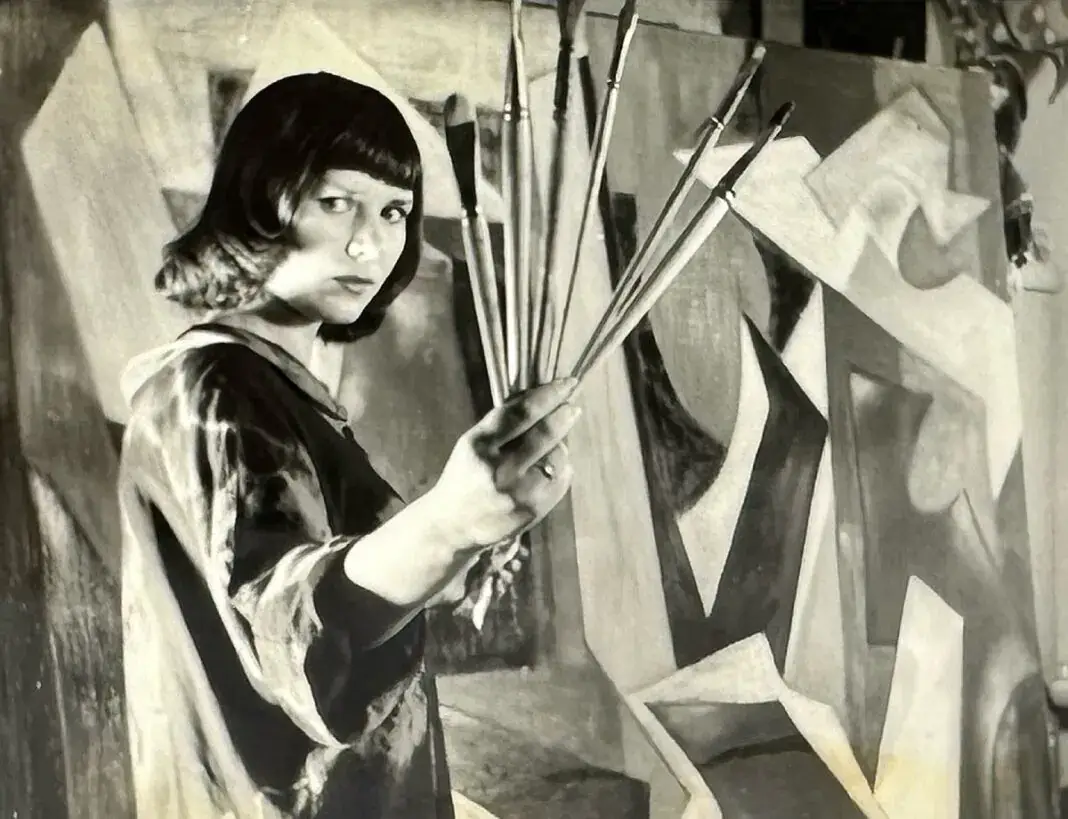
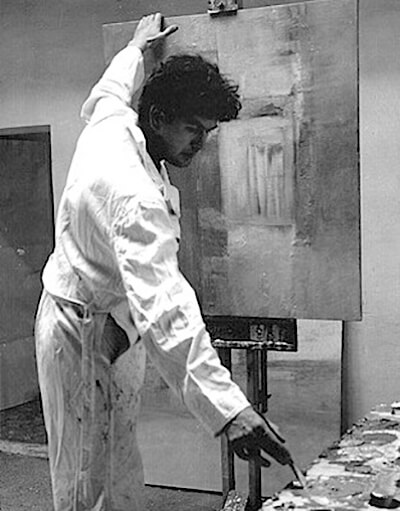
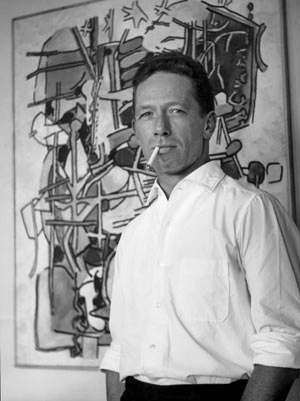
Top row (from left to right): Erwin Broner, Erwin Bechtold, Hans Laabs, Katja Meirowsky, and Antonio Ruiz. Photo: Julio Herranz. / Bottom row (from left to right): Katja Meirowski, Bob Munford, Heinz Trökes.
The name can be misleading. Grupo Ibiza 59 was not an art school with specific rules, nor did it produce a style that is immediately recognizable from one painting to another. Nor was there a manifesto outlining how the art should be interpreted. Its members came from different countries and followed their own artistic paths.
They did, however, share common ground: abstraction and an interest in experimenting with form, material, and texture, even though each artist approached this from a very different artistic language. What also united them was a practical need: the necessity to create a space where contemporary art could be exhibited, discussed, and connected—both within Ibiza and with the outside world. On an island with no museum of contemporary art and very few institutions dedicated to the avant-garde, the group organized exhibitions, forged connections, designed posters and invitations, and built a small, international cultural network. In a sense, that network was their true collective work.
An Ibiza still far from mass tourism
Grupo Ibiza 59 emerged at a peculiar moment in Spanish history. In 1959, Spain remained under the dictatorship of Francisco Franco, although its international isolation was slowly beginning to ease. At the same time, Spanish abstract art was gaining recognition abroad. Artists such as Antoni Tàpies, Antonio Saura, Manolo Millares, and Eduardo Chillida were beginning to participate in international exhibitions.
However, Ibiza was still even further removed from the country’s political and cultural centers. The transformation into a tourist destination had begun, but the island remained relatively poor, and daily life there bore little resemblance to the Ibiza that would emerge over the following decades. It was precisely these conditions—isolation, affordable prices, and a small community—that proved attractive to many foreigners.
Some artists had arrived even before the Civil War, as was the case with writer Walter Benjamin or dadaist artist Raoul Hausmann. After World War II, another wave began. For many Europeans, Ibiza offered not only a Mediterranean landscape but also a certain distance from a continent that had just endured decades of wars, dictatorships, and destruction. That same appeal—an affordable lifestyle, a certain freedom, and the feeling of being on the fringes of Europe—would resurface shortly thereafter with the arrival of the beatniks in Ibiza.
And, surprisingly, there was already an interested audience. In the summer of 1957, two years before the founding of Ibiza 59, the Sala Tanit welcomed 5,530 visitors between July and September. Fifty-eight artists exhibited a total of 614 works there, of which approximately one-third were sold. For a small island still in the early stages of its development as a tourist destination, these figures reveal a cultural scene that was considerably more active than one might imagine today.
El Corsario: the starting point in Dalt Vila
At the heart of that small art scene was El Corsario, a hotel-restaurant located in Dalt Vila that also became an exhibition space. The gallery, which opened in the 1950s, brought together foreign and local artists from the very beginning and would go on to become one of the key venues in Ibiza’s cultural life at that time.
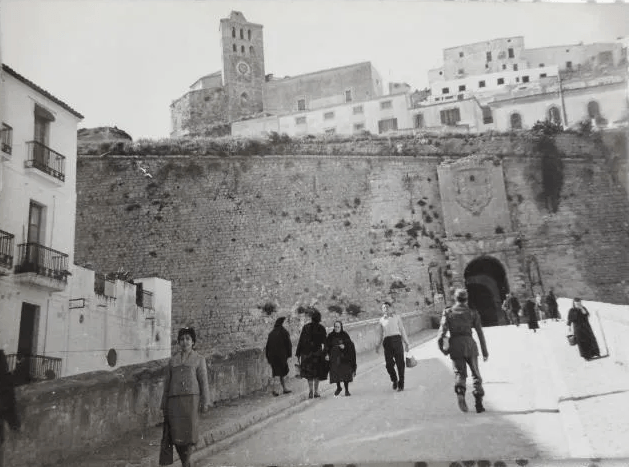
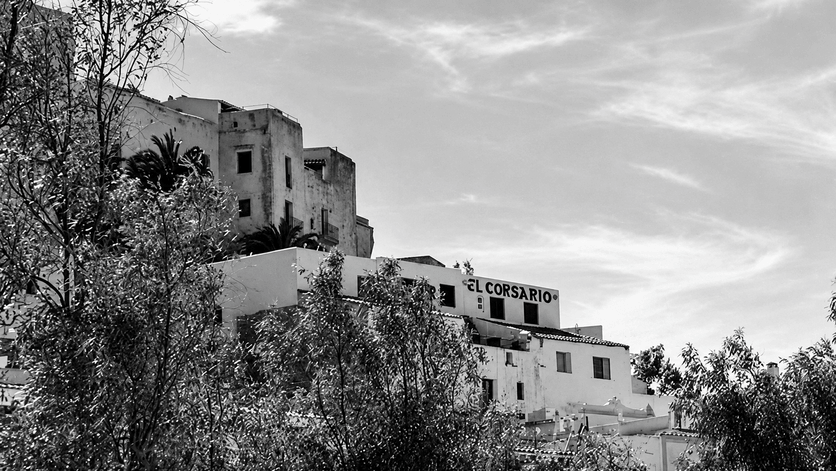
Left: postcard of Dalt Vila (1959) / Right: old photograph of El Corsario
In 1958, Emil Schillinger, then head of El Corsario, proposed to Erwin Bechtold that they organize contemporary art exhibitions there. But Bechtold did not want to serve as gallery director or find himself in the position of deciding which colleagues deserved to exhibit and which did not.
The solution, then, was to create an association of artists who recognized one another’s work and shared the space.
When Erwin Broner returned permanently to Ibiza in 1959, the project took shape. Broner drafted the founding document and became one of the collective’s main driving forces, although the group was intended to operate on a horizontal basis: each artist maintained their independence while also collaborating on the organization of the exhibitions.
There was something of a family-run business about it. Antonio Ruiz handled much of the gallery’s day-to-day operations; Munford and Bechtold designed graphic materials; Laabs helped with the installation; and Broner—who was both an architect and a painter—adapted the space. Furthermore, El Corsario didn’t just exhibit works by the group’s members: it also featured works and guest artists from other places.
In a city without an established arts infrastructure, printing an invitation, properly setting up an exhibition, or getting a foreign artist to send their works to Ibiza was no small feat and held significant importance.
Nine artists, nine ways of understanding modern art
The best way to understand Ibiza 59 is to look at its members individually. In part, their differences explain the group better than any attempt to identify a common style.
Erwin Broner
Erwin Broner was probably the group’s central figure. A German painter and architect of Jewish descent, he had left Germany after the Nazis came to power and first visited Ibiza in 1933. During that stay, he was fascinated by the island’s traditional rural houses: seemingly simple buildings, constructed according to practical needs, the climate, and available materials.
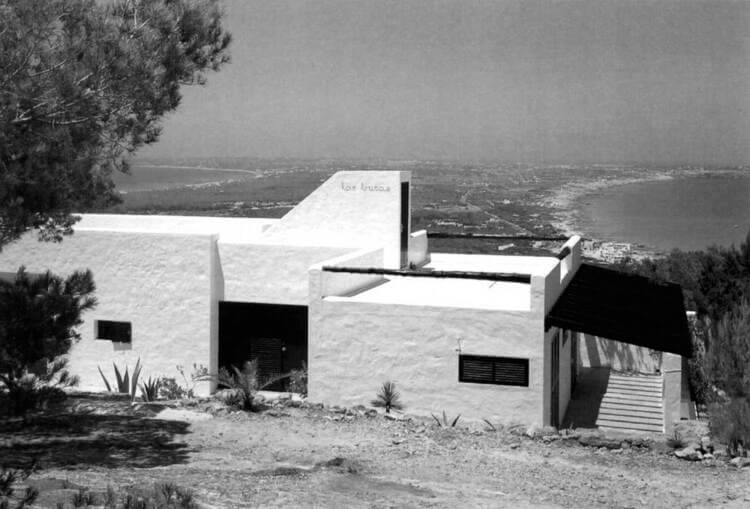
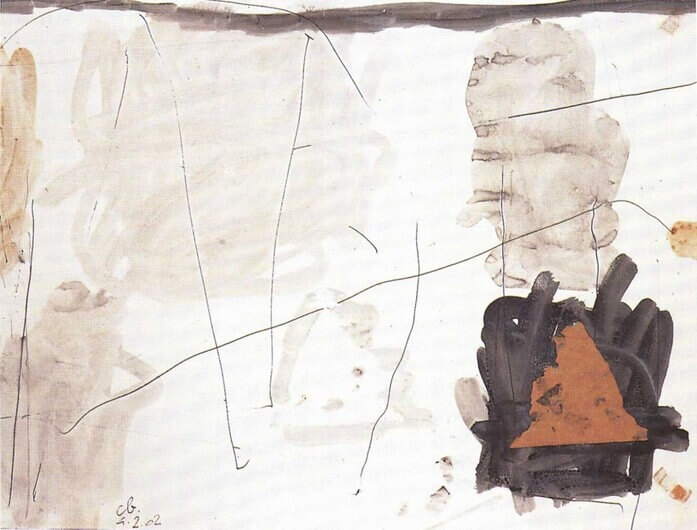
Works by Broner: Left: Casa Marcet (1968) / Right: “Untitled” (1962) – India ink and collage on paper.
Broner had been trained within the German modernist architectural movement, and his approach was closely aligned with the Bauhaus, rationalism, and later, Le Corbusier. In Ibiza, he discovered that rural architecture had arrived, through a completely different path, at some of the solutions that modern architects were consciously seeking: simplicity, functionality, and the absence of unnecessary ornamentation. This dialogue between international modernism and Ibizan tradition would define much of his architecture. His own Casa Broner, built in the Sa Penya neighborhood in 1960, remains one of the finest examples.
As a painter, however, he could be far less rational. He worked with abstraction, collage, ink, and various materials, with a freedom reminiscent of European Abstract Expressionism.
Erwin Bechtold
Erwin Bechtold first arrived in Ibiza in 1954 after spending time in Paris and Barcelona. He had trained as a printer and typographer, an experience that shaped his sensibility for composition and also allowed him to pursue a long career as a graphic designer.
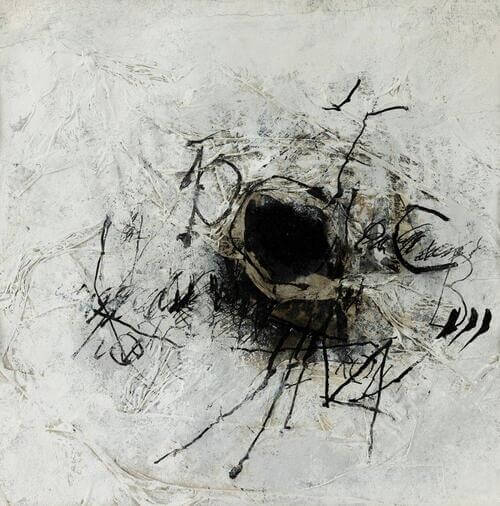
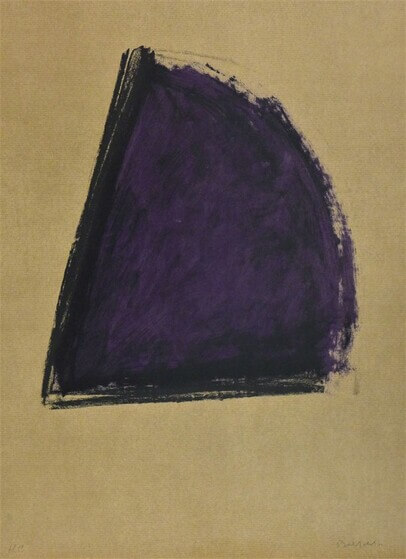
Works by Bechtold: Left: “Untitled” (1962). Mixed media on paper / Right: “Barcelona” (1984). Color lithograph on paper.
His painting from those years was close to Informalism: textural surfaces, splashes of color, organic forms, and free gestures. Over time, he evolved toward a much more geometric and controlled artistic language, in which he explored seemingly simple elements—the edge of a surface, an angle, an interrupted plane—until they became the focus of his work. Bechtold’s career path encapsulates the freedom of the Ibiza 59 Group quite well: not even its own members maintained throughout their careers the artistic language with which they had first joined the group.
Katja Meirowsky
Katja Meirowsky’s life story is perhaps the most extraordinary of the group. Born in 1920, she studied art in Berlin and, during the Nazi era, was involved with resistance circles. For a time, she had to live in hiding. After the war, she helped found Die Badewanne, an experimental cabaret featuring artists in postwar, war-torn Berlin. In the early 1950s, she settled in Ibiza, where she would live for nearly half a century, until returning to Germany around the year 2000.
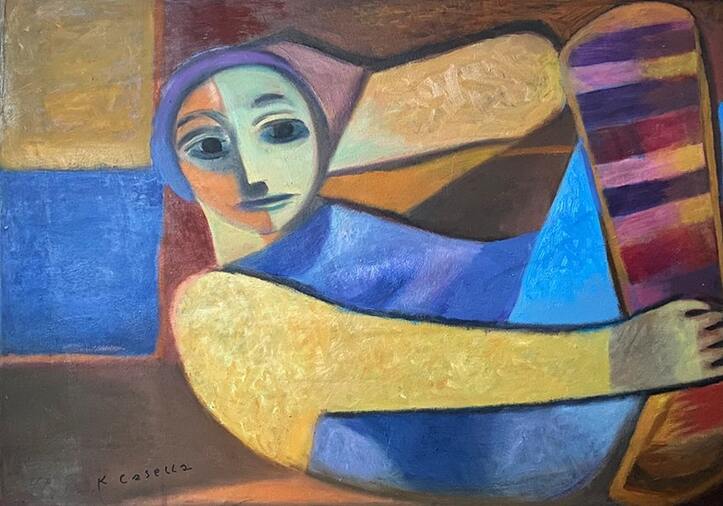
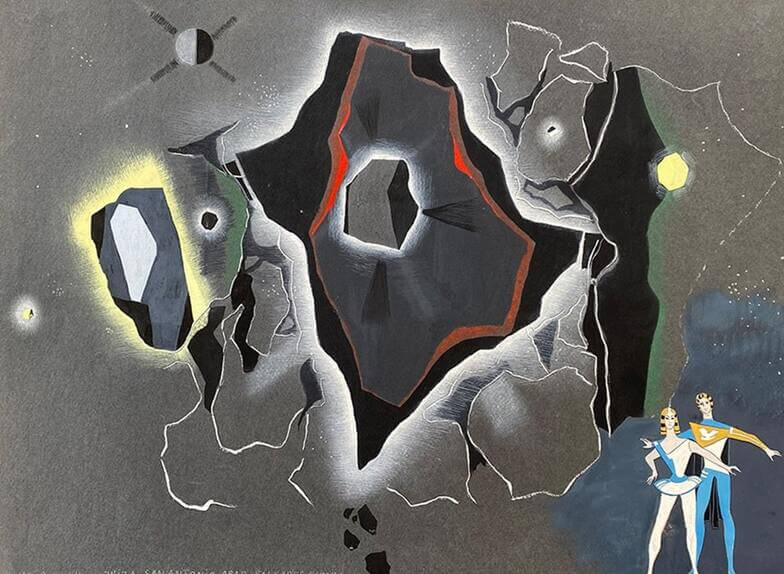
Works by Meirowsky: Left: “Pause” (1947). Oil on cardboard. / Right: “Bühnenbild” (1957). Gouache on paper.
Her painting is difficult to pigeonhole into a single category. She worked with abstraction, geometry, collage, and forms that seem to oscillate between landscapes, stage sets, and imaginary structures. In some works, there is a recognizable reference to nature; in others, space seems to have become a mental construct. Her training and interest in stage design are also evident in compositions reminiscent of stage sets, curtains, or theatrical spaces.
Hans Laabs
The German artist Hans Laabs had arrived in Ibiza in the early 1950s and, for decades, divided his time between Berlin and the island. His painting moved freely between figuration and abstraction: figures, interiors, still lifes, and seascapes could be simplified until they were reduced almost entirely to color and form.
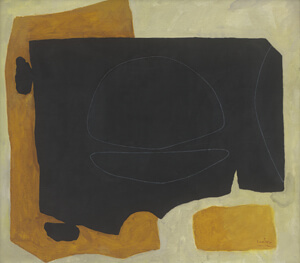
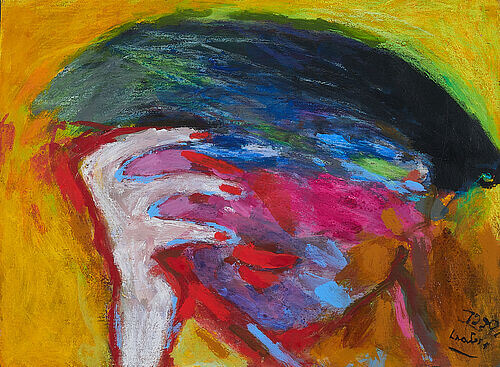
Works by Laabs: Left: “Komposition in Schwarz und Gelb” (1961). Oil on coarse-textured canvas. / Right: “Untitled” (1978). Acrylic.
Unlike other postwar artists who embraced a much more austere form of abstraction, Laabs’s work often exhibits a sense of lightness and a highly personal use of color. He himself acknowledged the influence that his long stays in the Mediterranean had had on his perception of color. As he described it, Ibiza physically entered his paintings.
Robert “Bob” Munford
The American Bob Munford brought a different sensibility to the group. He had arrived in the Pitiusas in the mid-1950s after studying in the United States and shifted from a style of painting close to Abstract Expressionism toward increasingly graphic images.
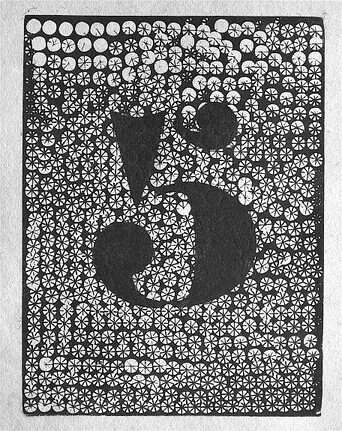
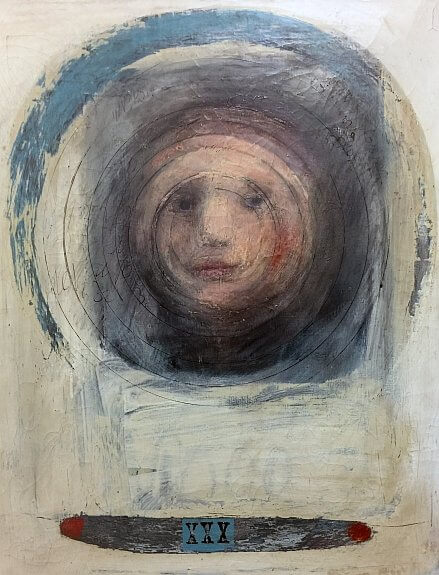
Works by Munford: Left: “Number 5” (1960). Gouache and ink on paper. / Right: “Portrait of Walker” (1971). Mixed media.
Numbers, writing, silhouettes, diagrams, photographs, and repeated forms began to appear in his works. This visual vocabulary brought him early on into contact with something that would soon be identified as Pop Art. While many of his peers remained primarily connected to the European avant-garde, Munford indirectly introduced another artistic dialogue: the one unfolding on the other side of the Atlantic.
Heinz Trökes
Heinz Trökes was already an artist with significant international experience when he arrived in Ibiza. He had studied with Johannes Itten—one of the key figures associated with the Bauhaus—and his career had been hindered during the Nazi era. After the war, he became a leading figure in German abstract art.
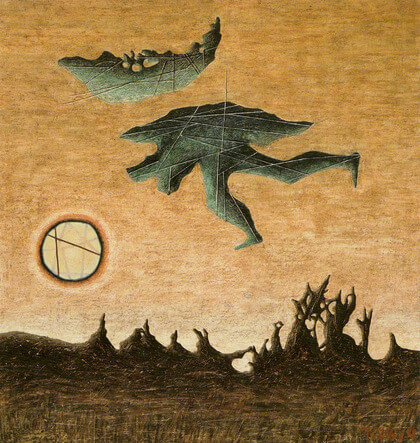
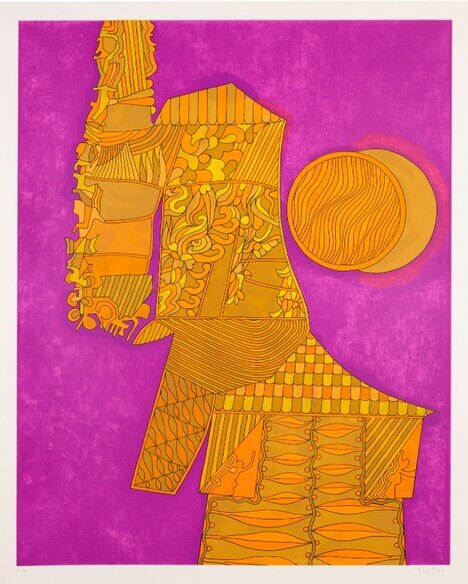
Works by Heinz Trökes: Left: “Am Mars” (1948). Oil on canvas. / Right: “Rebus” (1970). Color silkscreen on paper.
His paintings combined abstraction with elements reminiscent of maps, symbols, organisms, or imaginary landscapes. They were not depictions of the visible world, nor were they cold geometry: they seemed to depict territories that existed only within the painting itself.
Trökes settled in Ibiza in the early 1950s and brought to the group connections with a generation of European artists who had directly experienced the cultural rupture caused by Nazism and the war.
Egon Neubauer
Egon Neubauer, born in Magdeburg in 1920, had studied under the painter Bernhard Dörries and, as early as 1949, won one of the first postwar art prizes awarded by the city of Hanover. He worked not only as a painter but also in printmaking, textiles, and sculpture.
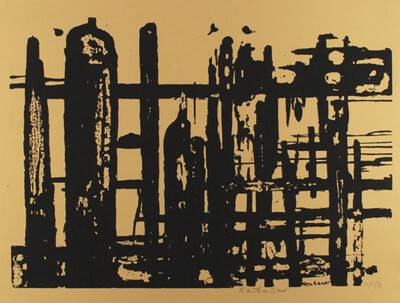
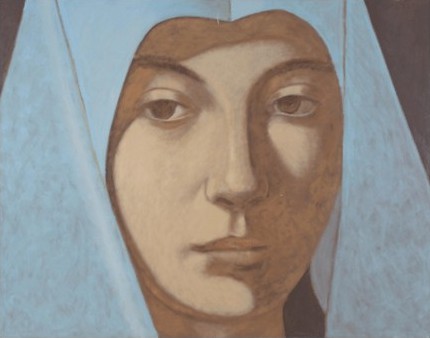
Works by Neubauer: Left: “Abstract Composition” (1960). Print on paper. / Right: “Woman with Blue Scarf” (undated). Oil on canvas.
He moved temporarily to Ibiza in 1954 and later joined Ibiza 59. His presence serves as a reminder of just how closely that artistic community was connected to Germany’s postwar cultural reconstruction: several of its members had personally experienced Nazism, the war, exile, or the destruction of their cities before finding themselves on a Mediterranean island.
Antonio Ruiz
Antonio Ruiz was a ceramist in the founding group and one of the few Spaniards in the group. Born in Soria, he had studied in Madrid and trained at the National School of Ceramics before settling in Ibiza.
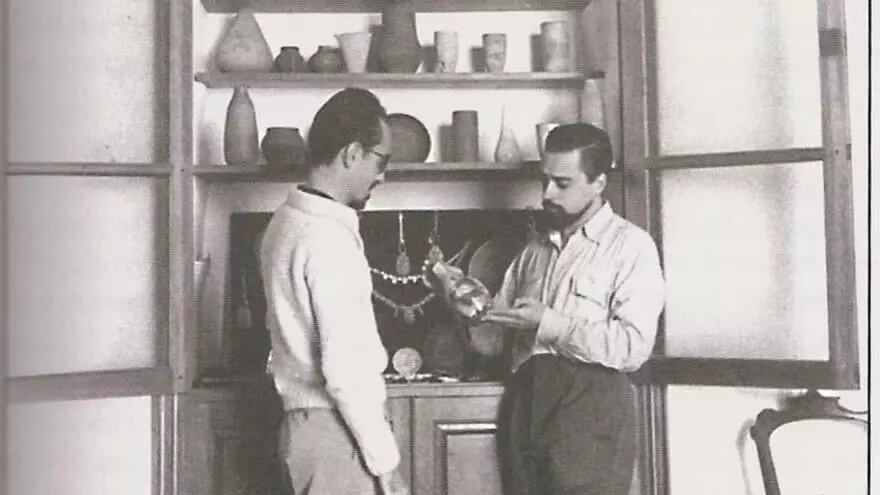
Antonio Ruiz (right) next to several of his ceramic pieces.
His importance was not limited to his own work. Ruiz was one of those figures capable of making a cultural scene thrive: he directed the El Corsario gallery and played an active role in organizing exhibitions and events. Ceramics also introduced a different dimension to a collective dominated by painters: an interest in abstraction, material, and form did not have to be confined to the surface of a canvas.
Bertil Sjöberg
The Swede Bertil Sjöberg rounded out that extraordinarily international group. Having been educated in Scandinavia and other European centers, he had been exposed to modern French painting at an early age and maintained a long-standing connection with the Mediterranean.
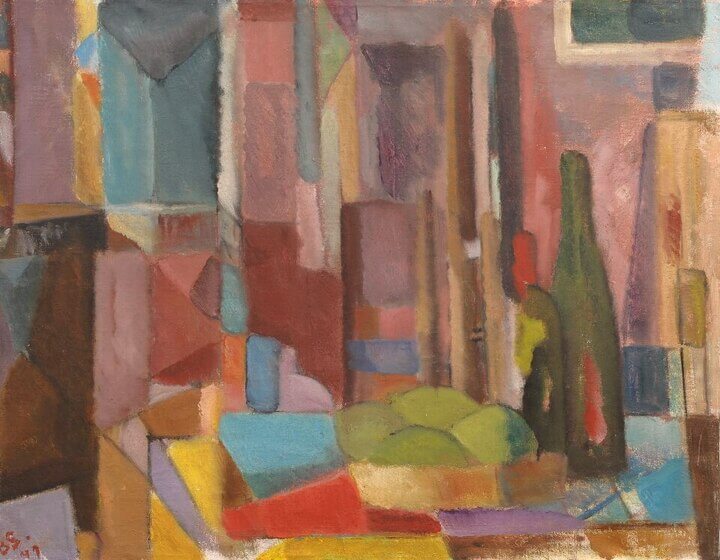
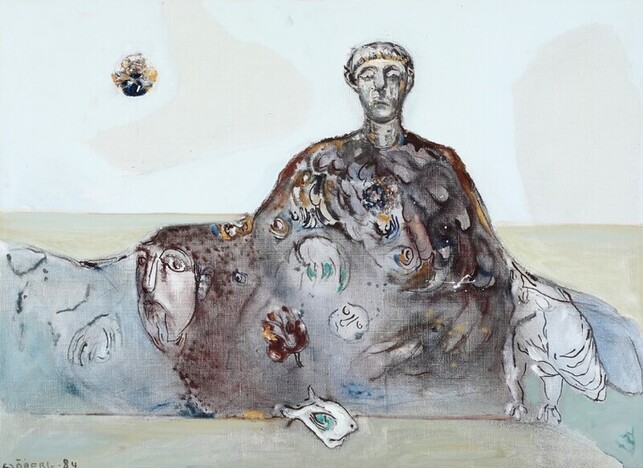
Works by Sjöberg: Left: “Stilleben” (1949). Oil on canvas. / Right: “Metamorfose” (1984). Mixed media.
His work included painting and drawing, with a particular focus on ink and wash. In later works, such as his Tanit Series, abstraction blends with references that seem to allude to forms, symbols, and associations with the island itself. In his work, as in that of several of his peers, Ibiza does not necessarily appear as a literally depicted landscape, but rather as a territory that slowly transforms into a visual language.
Viewed one after another, it is difficult to imagine that these nine artists could have signed a joint manifesto. Broner approached abstraction with a sensibility also shaped by architecture; Bechtold moved from textural surfaces to increasingly geometric compositions; Meirowsky oscillated between abstract structures and almost dreamlike spaces. Munford was beginning to incorporate signs and elements reminiscent of Pop Art, while Trökes worked with forms reminiscent of maps or imaginary landscapes. Laabs alternated between figuration and abstraction, and Ruiz carried that same experimental spirit over into ceramics.
There was a shared interest in abstraction, experimentation, forms, and textures, but no specific formula.
From Dalt Vila to Europe
El Corsario’s exhibitions soon became social events within the island’s small cultural circle. Sales weren’t always brisk, but the gallery served as a place to meet, discuss, get to know artists, and bring works into circulation that otherwise would have been unlikely to reach Ibiza. In addition to the group’s own members, guest artists such as Juan Genovés, Manuel Hernández Mompó, Eusebio Sempere, Hans Hartung, Joan Miró, and Vieira da Silva participated in its exhibitions. The exchange, therefore, worked both ways: Ibiza welcomed artists and works from abroad, while its own residents began to gain visibility outside the island.
The group’s first major breakthrough came in 1961, just two years after its founding, with an exhibition at the Haus am Waldsee in West Berlin. The exhibition ran from March 18 to April 16 and even had its own catalog. For a collective that had formed around a small gallery in Dalt Vila, this meant presenting themselves as a group to the public in one of Europe’s cities with the richest artistic traditions.
London came three years later. In October 1964, the exhibition *Inspiration Ibiza*, organized by the Ivan Spence Gallery at the Leicester Galleries, brought together members of Ibiza 59 alongside other foreign artists living on the island. The title is revealing: by then, what was beginning to attract interest abroad was no longer just a few specific painters, but Ibiza as a place of creation. The island was beginning to acquire its own artistic identity abroad, just as Ibiza 59 was coming to the end of its run as a collective.
Grupo Puget: a different view of Ibiza
The Ibiza 59 movement did not mean that local artists abandoned their own traditions. In 1962, the Puget Group was formed, consisting of four Ibizan painters: Vicent Calbet, Vicent Ferrer Guasch, Antoni Pomar, and Antoni Marí Ribas “Portmany.”
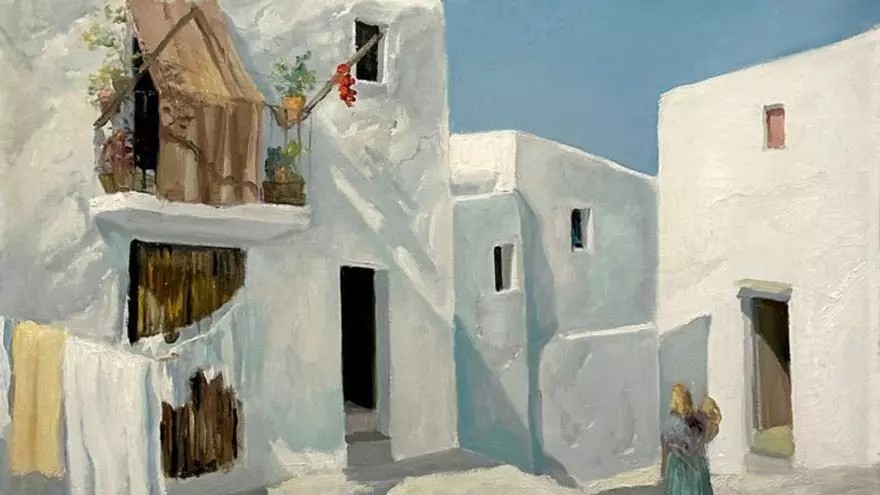
View of Sa Penya (1960s), by Vicent Ferrer Guasch. Oil on canvas.
Its name paid tribute to Narcís Puget Viñas, considered a pioneer of modern Ibizan painting. In contrast to the predominantly foreign and abstract character of Grupo Ibiza 59, the members of the Puget Group drew on a figurative tradition much more closely linked to the landscape, light, people, and everyday life on the island. Their painting had Impressionist roots and an explicit interest in Ibizan culture.
For this reason, it has sometimes been interpreted as a local response to the dominance of foreign and abstract artists. The reality seems to have been less contentious. The artistic differences were evident, but there were good personal relationships between the two circles. In fact, the Puget Group was invited to exhibit at El Corsario.
The contrast between the two groups is interesting because it reveals two simultaneous ways of engaging with the same island. For some, Ibiza was the place from which to participate in new international trends; for others, it was precisely its landscape, its inhabitants, and their ways of life that deserved to continue being depicted.
What remained after 1964
Grupo Ibiza 59 ceased to function as a collective in 1964. One of the reasons cited is quite simple: while Ibizan society at the time might have been interested in that art, it could hardly keep up with the pace of exhibitions the group was able to organize. Its members continued to work independently, and many maintained their ties to the island.
By then, however, the art scene in Ibiza had already changed. Abstraction and new European movements were no longer virtually unknown, and Ibizan artists such as Rafael Tur Costa were in touch with that scene and were pursuing their own explorations within modern art.
The year 1964 is significant because, at the same time that Ibiza 59 was disbanding, the first Ibiza Biennial was held. There is insufficient evidence to present the Biennial as a direct continuation of the group, but it is difficult to view the two as completely separate histories. In the preceding years, Ibiza 59, El Corsario, and other galleries had organized exhibitions, established international contacts, and cultivated an audience accustomed to encountering contemporary art on the island. The Biennial brought some of that activity to an institutional level.
In fact, that same year, the idea of creating a museum of contemporary art began to take shape. The award-winning works from the Biennial were to form part of its initial collection, and in 1969, the Museu d’Art Contemporani d’Eivissa (MACE) finally opened. It was one of the first Spanish museums dedicated specifically to contemporary art.
In just a decade, the scene had evolved from one sustained largely by artists, small galleries, and personal connections to one featuring an international biennial and a public museum. Grupo Ibiza 59 did not achieve this on its own, but it had helped create the environment in which it could take place.
Ibiza 59 also helped shape an image of the island that went beyond its beaches. Before becoming a hippie destination, an international hub for electronic music, or a luxury real estate market, Ibiza was already known in certain European circles as a place where artists, architects, and writers could settle, work, and meet people from other countries. That pattern would continue over the following decades.
For five years, the members of Grupo Ibiza 59 helped demonstrate that an island—still small, poor, and far from the major artistic centers—could be part of the cultural movements of its time. Their legacy lies less in a shared style than in the space they helped create for those who came after them.
References:
Fundación DOCOMOMO Ibérico / Erwin Broner: “Erwin Broner” (s. f.), by Fundación DOCOMOMO Ibérico.
Museu d’Art Contemporani d’Eivissa (MACE) / colección Grupo Ibiza 59: “El Museu d’Art Contemporani d’Eivissa reordena la colección de obras del Grupo Ibiza 59” (2021), by MACE / Ajuntament d’Eivissa.
Haus am Waldsee / archivo de exposiciones: “Exhibition chronicles” (1961), by Haus am Waldsee — registro de la exposición group ibiza 59, celebrada del 18 de marzo al 16 de abril de 1961.
Es Baluard Museu / Katja Meirowsky: “Katja Meirowsky. La acción roja y la membrana” (2024), curated by Bartomeu Marí and Imma Prieto.
Dialnet / arte y turismo en Ibiza: “Arte de vanguardia en la Ibiza turística” (2016), by José Ramón Cardona and María Isabel Ramón Cardona.